
Donald W. Katzner
Download PDF| Description |
|---|
|
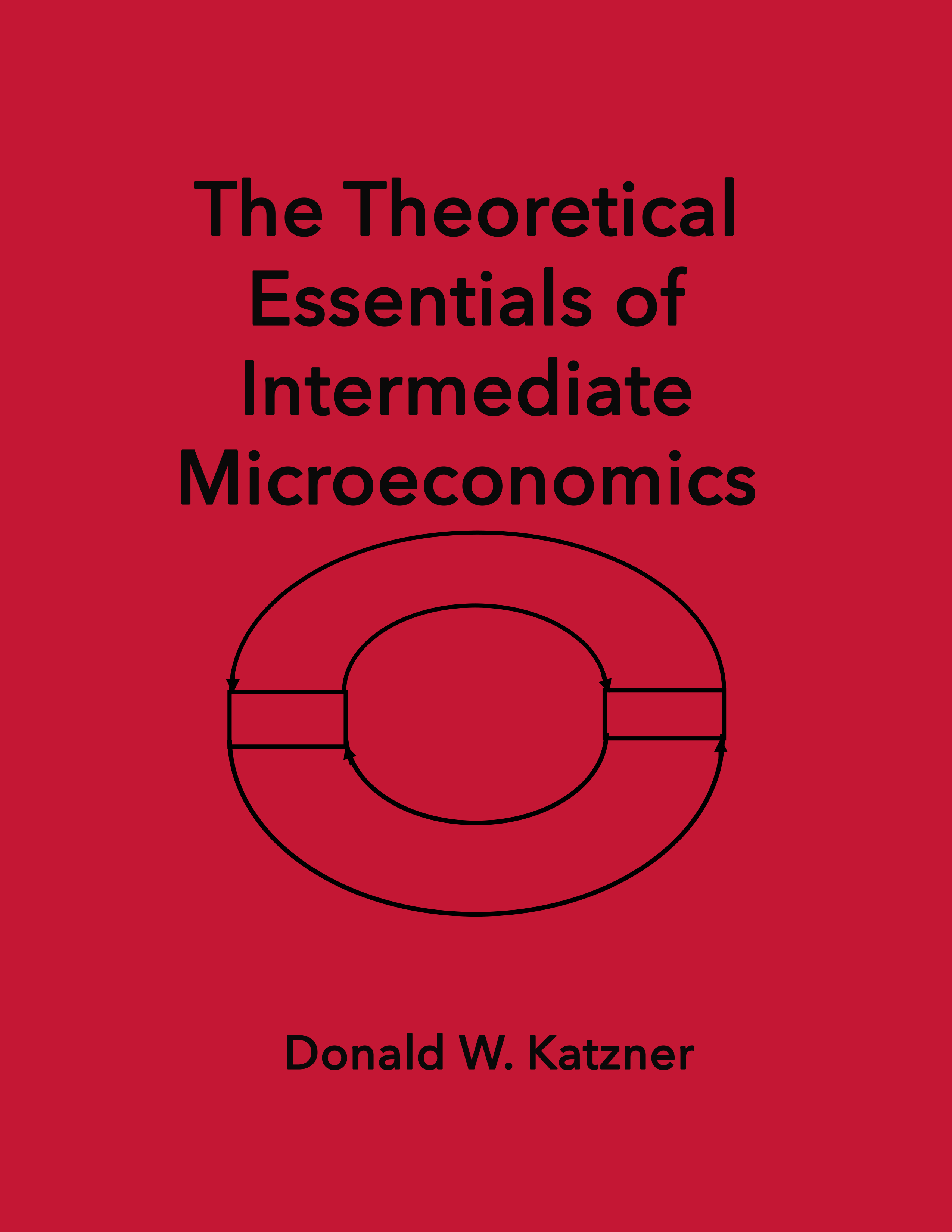
The main focus of this book is the presentation of a clear and uncluttered discussion centered narrowly on the basic theoretical ideas, arguments, and interrelationships that constitute the traditional explanation of the workings of the perfectly competitive microeconomy, along with a few examples of market failures to account for more realistic microeconomic circumstance. Many details and asides that appear in standard textbooks are omitted. Discussion is set in the context of a world with two final goods, two persons, two firms, and two inputs or resources and is often phrased in reference to graphs. There is no game theory and no discussions of uncertainty and behavioral economics. Nor are there any applications. Only a few examples, usually abstract, illustrate theoretical ideas. Topical coverage includes the theory of the consumer, the theory of the firm, the theory of markets, general equilibrium, welfare, monopoly, monopolistic competition, oligopoly, externalities, and public goods. The second edition of this book differs from the first only in that it corrects errors, fills in gaps in reasoning, and adds clarity to arguments. |
Eric M. Tucker, Howard T. Everson, Eva L. Baker & Edmund W. Gordon
Download PDF| Description |
|---|
|
Volume III of the Handbook for Assessment in the Service of Learning bridges the gap between aspiration and application, by translating core design principles into practice through a collection of examples. This volume presents tangible "existence proofs" from a broad range of educational contexts—including digital learning platforms, PreK–12 classrooms, game-based learning environments, and skills-based credentialing programs. Each worked example can be understood through three complementary lenses: assessment as an evidentiary argument, as a feedback loop, and as a social practice. This framework reveals how thoughtfully designed assessment systems with actionable feedback can balance the need for evidence of learning. By showcasing assessments that are seamlessly integrated with learning and instruction, this volume advances the proposition that to assess is, fundamentally, to teach and to learn. It offers practical models and designs that embed assessment within instruction to cultivate skills and support meaningful learning. This Handbook is intended for a broad audience, from test developers, assessment researchers, psychometricians, and learning scientists to educators, policy makers, and designers. It is a resource for anyone interested in using assessment to help learners learn. An indispensable resource, it guides policymakers and PreK-12 leaders in shaping the future of assessment, while offering developers and researchers a blueprint for designing and scaling the next generation of assessments for learning. Edmund W. Gordon, Teachers College, Columbia University (Emeritus); Yale University (Emeritus) Stephen G. Sireci, University of Massachusetts Amherst, Center for Educational Assessment Eleanor Armour-Thomas, Queens College, City University of New York Eva L. Baker, University of California, Los Angeles, Center for Research on Evaluation, Standards, & Student Testing (CRESST), School of Education & Information Studies (SE&IS) Howard T. Everson, Graduate Center, City University of New York Eric M. Tucker, The Study Group |
Stephen G. Sireci, Eric M. Tucker & Edmund W. Gordon
Download PDF| Description |
|---|
|
Volume II of the Handbook for Assessment in the Service of Learning moves from foundational principles to the conceptual tools and methods needed to build assessment systems that actively improve, not just measure, learning. Section I offers frameworks for learner‑centered assessment—foregrounding formative practice, self‑regulated learning, personalization and equity, validity, and social justice—so that technical quality and justice are co‑equal design imperatives. Section II translates these ideas into practice: game‑based learning, educative portfolios, dynamic learning maps, culturally and linguistically responsive co‑design, redesigned score reporting, and analyses of learner–system interactions that turn digital traces into actionable evidence. Volume II of this Handbook for Assessment in the Service of Learning provides blueprints and validation guidance to inform assessment systems that support learners—bridging Volume I’s foundations to Volume III’s examples. It also advanced the series’ proposition that assessment, teaching, and learning are inseparable. This Handbook is intended for a broad audience, from test developers, assessment researchers, psychometricians, and learning scientists to educators, policy makers, and designers. It is a resource for anyone interested in using assessment to help learners learn. An indispensable resource, it guides policymakers and PreK-12 leaders in shaping the future of assessment, while offering developers and researchers a blueprint for designing and scaling the next generation of assessments for learning. Edmund W. Gordon, Teachers College, Columbia University (Emeritus); Yale University (Emeritus) Stephen G. Sireci, University of Massachusetts Amherst, Center for Educational Assessment Eleanor Armour-Thomas, Queens College, City University of New York Eva L. Baker, University of California, Los Angeles, Cetner for Research on Evaluation, Standards & Student Testing (CRESST), School of Education & Information Studies (SE&IS) Howard T. Everson, Graduate Center, City University of New York Eric M. Tucker, The Study Group |
Eric M. Tucker, Eleanor Armour-Thomas & Edmund W. Gordon
Download PDF| Description |
|---|
|
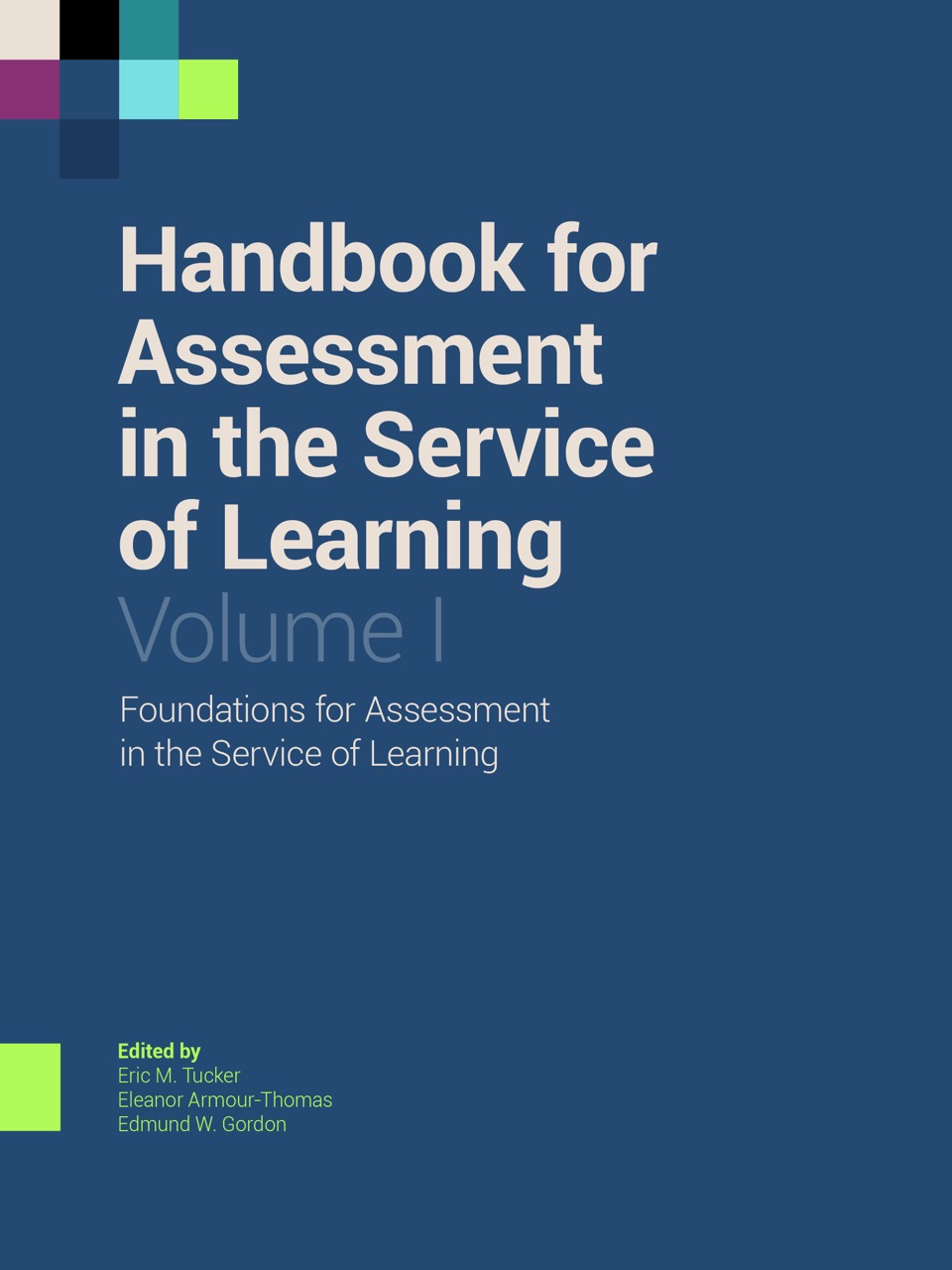
Volume I of the Handbook for Assessment in the Service of Learning offers a theoretical and research-grounded vision for transforming educational assessment into a catalyst for learning. Drawing on contemporary learning sciences, measurement theory, and improvement science, the volume is organized into three sections that offer principled design and conceptual frameworks for integrating assessment with teaching and learning; ground assessment in the social, cultural, and developmental nature of how people learn; and examine how emerging technologies like artificial intelligence might enrich balanced assessment practices while upholding technical requirements of validity: fairness, scientific soundness, utility and creditability. Informed by the vision of the Gordon Commission for the Future of Assessment in Education, this volume explores rethinking assessment as an integral component of pedagogy that informs the processes for learning and its improvement over time rather than just a final evaluation of the status of learning achieved. It provides the foundations for building assessment systems that are human-centered, just, and truly in the service of every learner. Audience This Handbook is intended for a broad audience, from test developers, assessment researchers, and learning scientists to educators, policy makers, and designers. It is a resource for anyone interested in using assessment to help learners learn. An indispensable resource, it guides policymakers and PreK-12 leaders in shaping the future of assessment, while offering developers and researchers a blueprint for designing and scaling the next generation of assessments for learning. Handbook for Assessment in the Service of Learning Series Editors Edmund W. Gordon, Teachers College,Columbia University (Emeritus); Yale University (Emeritus) Stephen G. Sireci, University of Massachusetts Amherst, Center for Educational Assessment Eleanor Armour-Thomas, Queens College, City University of New York Eva L. Baker, University of California, Los Angeles, Center for Research on Evaluation, Standards, & Student Testing (CRESST), School of Education & Information Studies (SE&IS) Howard T. Everson, Graduate Center, City University of New York Eric M. Tucker, The Study Group |